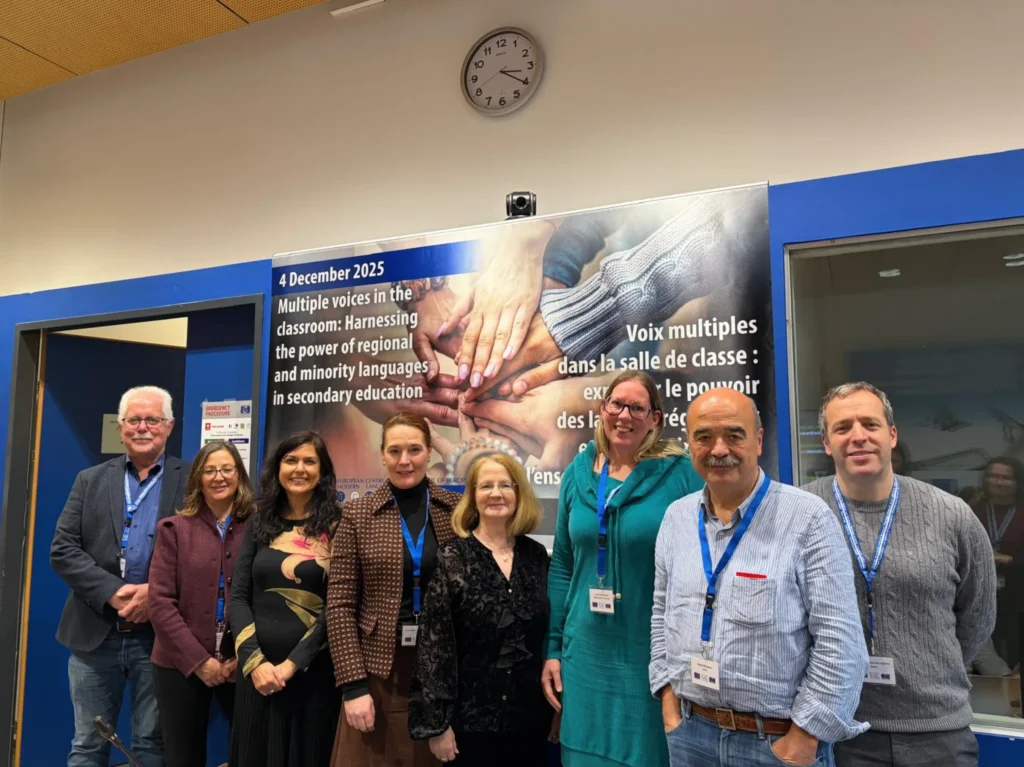
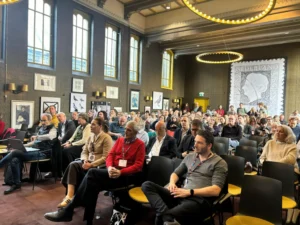
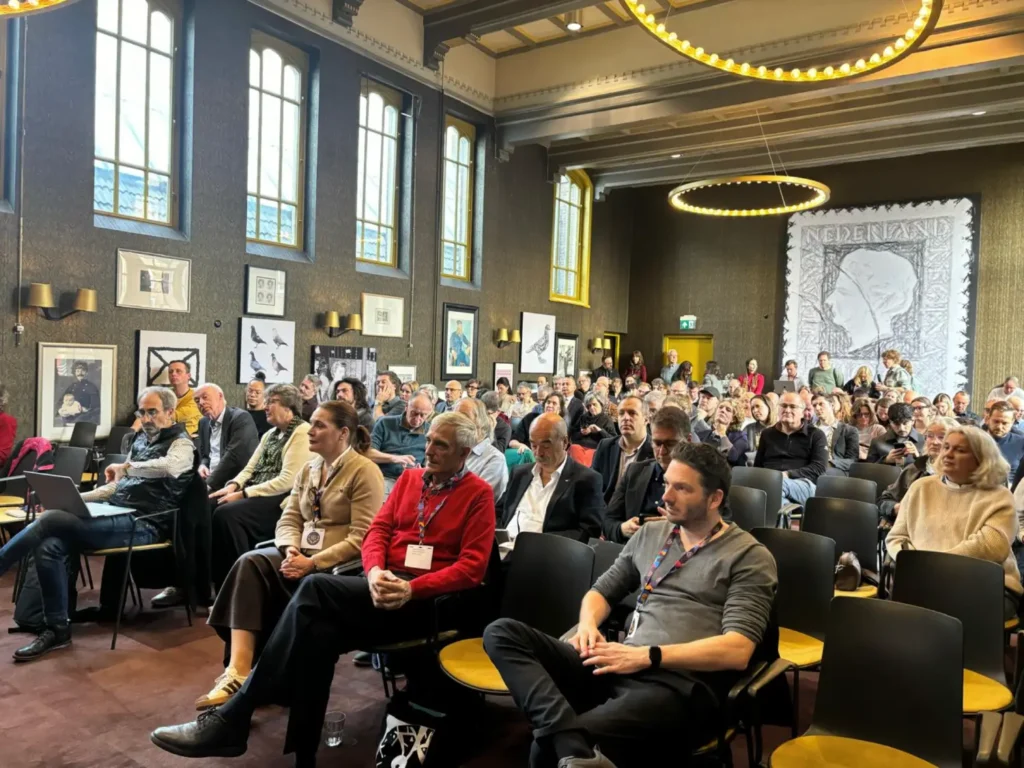
The ECML–European Commission Colloquium, entitled “Multiple voices in the classroom: Harnessing the power of regional and minority languages in secondary education”, was held on 4 December 2025 in Graz, bringing together researchers, policymakers and practitioners from across Europe to reflect on the role of regional and minority languages (RMLs) in increasingly multilingual classrooms.
Organised by the European Centre for Modern Languages (ECML) and the European Commission, with the cooperation of the Network to Promote Linguistic and Mercator- Fryske Academy, the event provided a platform to exchange research findings, policy perspectives and practical experiences on how linguistic diversity can be transformed into an educational asset rather than a challenge.
The colloquium opened with welcoming remarks from representatives of the ECML and the European Commission, followed by a keynote address by Tomasz Wicherkiewicz (Adam Mickiewicz University, Poznań). His intervention explored the tensions between migration, education and linguistic diversity, drawing lessons from the Polish school context and setting the conceptual framework for the day.
Throughout the morning, participants examined concrete experiences of inclusion in minority-language contexts. Mandira Halder (Finland) presented research on the integration of pupils with a migrant background in Swedish-medium education in Finland, complemented by video testimonies illustrating the benefits of learning a regional or minority language for both educational success and social inclusion.
A central moment of the colloquium was the panel discussion on what motivates newcomers to learn regional and minority languages, chaired by Anna Jungner-Nordgren, Chair of the Network to Promote Linguistic Diversity (NPLD). The panel brought together experts from Austria, Switzerland, the Netherlands and Portugal, and highlighted the importance of language attitudes, school environments and institutional support in fostering positive engagement with RMLs among newly arrived pupils. The discussion underlined the added value of RMLs as tools for integration, community belonging and intercultural dialogue.
The afternoon sessions focused on participatory reflection and practical outcomes. Following group work and collective reporting, a second panel addressed the challenges faced by RMLs in multilingual classrooms, showcasing best practices and successful pedagogical models from different European contexts. This featured contributions from Finland, Spain, Romania and Ireland.
The colloquium concluded with the presentation of seven proposals to better value regional and minority languages in European schools, delivered by Aurelio La Torre. A reception hosted by the ECML provided an opportunity for further exchanges and networking.
The strong presence and active involvement of NPLD leadership and member organisations throughout the event reaffirmed the Network’s commitment to advancing inclusive language policies and educational practices at European level, and highlighted the relevance of regional and minority languages as a cornerstone of linguistic diversity, social cohesion and democratic education in Europe.