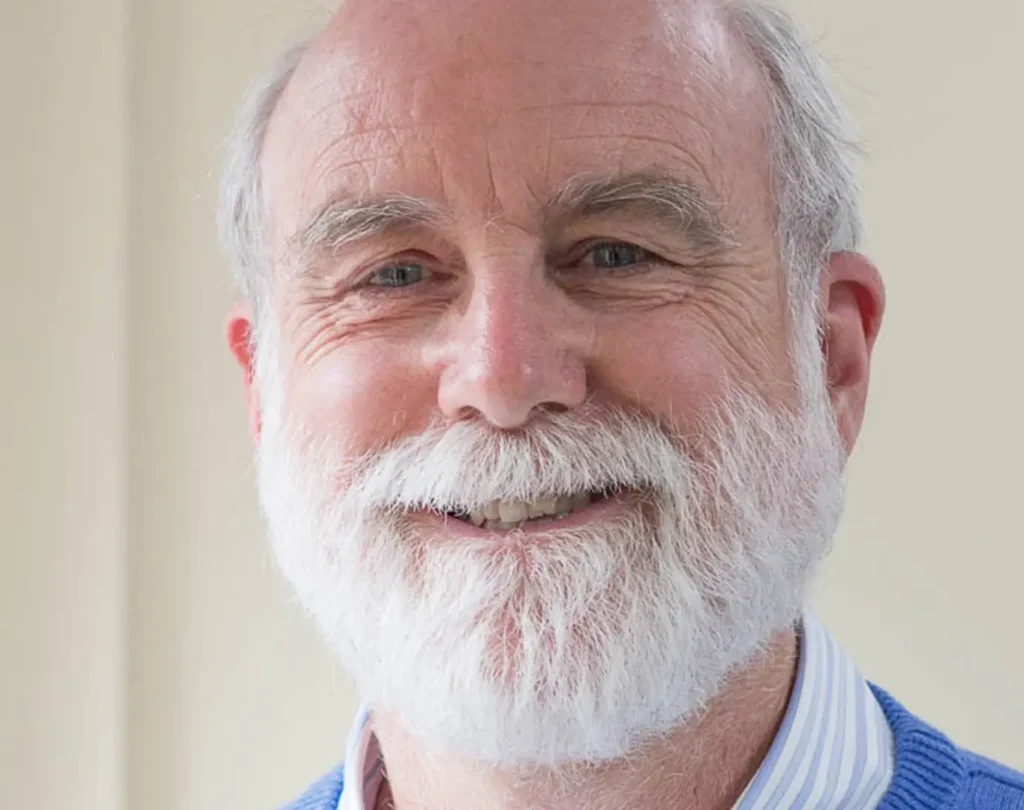
Below, Jeremy Evas, friend, former colleague and former research student of Colin Williams, pays tribute to a scholar, mentor and human being whose influence extended far beyond academia.
“Colin Haslehurst Williams FLSW, Emeritus Professor at Cardiff University’s School of Welsh and a Fellow of the Von Hügel Institute, University of Cambridge, died, far too early, of motor neurone disease, on Saturday 2 May 2026. He was an internationally respected scholar of language policy and planning, renowned for his comparative work, particularly on Wales, Canada, and parts of Europe. He was admired for bringing academic rigour into public policy through research, teaching, and advisory roles.
I first heard Colin’s calm, authoritative voice in 1995, on BBC Radio 4. I was on my way to be interviewed by him for a postgraduate research scholarship at the then University of Wales, Cardiff. He was discussing language policy in Wales and Scotland. And I was about to walk into his office, terrified. That interview changed my life, and my three-decade friendship with him enriched it immeasurably.
Colin was brought up in a bilingual household in Barry. His family background was in the Rhondda and Dorset, unusual for a Welsh speaker of his era in that area. He carried this with quiet pride. He was among the first cohorts at Ysgol Gyfun Rhydfelen in Pontypridd, a newly opened bilingual secondary school in south Wales. There he became head boy, excelled at sport, and developed the warm, welcoming manner that would define him as a scholar and a friend.
He read geography and politics at Swansea, graduating with first-class honours in 1972. His doctorate, ‘Language Decline and Nationalist Resurgence in Wales,’ awarded in 1978, started his career’s central preoccupation: how do policies and politics shape linguistic survival? His view was that sentiment and enthusiasm, though necessary, were nowhere near enough in language policy. For him, what was also needed was a judicious combination of law, outcomes-based planning, intelligent promotion, and holistic institutional support.
His research career was intercontinental. It took him to Ottawa, Dublin, Penn State, Staffordshire, Cardiff, Oxford, Cambridge — the list is far from exhaustive. This gave him a comparative eye that the more parochial of us may have lacked.
For Colin, minority language politics was not a peripheral grievance. It was a fundamental test of democratic governance. His extensive publications are a body of work intended not merely to be read, but to be acted upon.
He also foresaw the role of technology in minority language revitalisation. This made him even more endearing, as I regularly had to act as his technical support.
I came to my interview as the first in my family to have gone to university, nervous and expecting it to go badly. What I found was a man who put me at ease and made me feel like I belonged in the room. Colin always made people feel they belonged in the room. He was the embodiment of what I would much later understand to be called psychological safety.
In response to every piece of work I submitted, Colin asked the same incisive question: ‘so what?’ From him, though, it signalled discipline, not dismissal — a reminder that work matters only if you start it. And that it counts only if it earns its place on the page.
His appointment to the former Welsh Language Board in 2000 brought his thinking into the public sector. His fingerprints can be found across legislation and strategy that underpin many of the world’s minority languages. He played a role in the negotiations around the Good Friday Agreement. In so doing, he brought to Ireland the same rigorous, comparative intelligence he had long applied to Wales and others.
During the first decade after the establishment of the European Network to Promote Linguistic Diversity (NPLD) in 2007–08, Colin played a significant role as adviser and external researcher to its members. This built on earlier research and evaluation work for Foras na Gaeilge in Ireland, Svenska kulturfonden in Finland, and the former Welsh Language Board. That work led to From Act to Action, a comparative study of the strategies and methods these bodies had developed to promote and facilitate the use of their respective languages.
His interest in comparing, contrasting, and evaluating different approaches to language promotion continued throughout his involvement with NPLD. Central to that work was an extensive programme of interviews with many of the network’s key figures, with particular attention to the role of public and civil servants, whom he regarded as pivotal to the success of language policy in practice. He presented his findings regularly to NPLD members and, towards the end of the network’s first decade, drew them together into a series of recommended activities and strategies which, in his view, supported effective and efficient language planning in countries and regions committed to sustaining lesser-used languages.
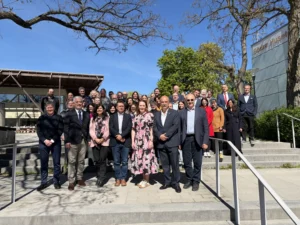
At a joint conference by Cymraeg 2050 and Cardiff University’s School of Welsh, held in 2024 to honour his contribution to language policy, people from all over the world gathered to attest to how far Colin’s influence had travelled. It felt more like a gathering of family and friends than an academic event. Those new to Colin said they had never experienced anything like it. For all who had met him, it was no surprise. It was here too that we all had the opportunity to thank Colin in person. The event can be viewed on YouTube.
The conference, as it turned out, was not his valediction. Colin was already deep into writing his three final volumes and seeing into print poetry he had written at a young age.
For his final book, Minority Language Revitalisation and Regulation, due later this year, he interviewed ministers, commissioners, civil servants, and researchers. The book ranges from the Gaeltacht to Finnish language legislation; from Canada’s Office of the Commissioner of Official Languages to the emerging challenge of AI and digital technology for minority language survival. It is characteristic of a man who refused, even as motor neurone disease impinged on his ability to type, to leave a blank page.
The tributes that followed his death dwelt less on the policy or the academic volumes than on the qualities of the man who penned them. He was immensely kind. He instilled confidence in students and colleagues. And he was mischievous too. The titles of his later pieces give a flavour of the wit beneath the scholarship. ‘Wake Me Up in 2050!’ is a wry reckoning with the ambitions of the Cymraeg 2050 Welsh language strategy. From Act to Action captured, in characteristically sharp form, the possible distance between policy on paper and change on the ground.
He loved jazz. He loved sport. He personified ‘educere’ (to draw out), one of the roots of ‘education.’ With a gentle question, a half-smile, and the sense that he had all the time in the world for them, he drew out from students what they did not know was within them.
On first meeting Colin, he was charming (and disarming). Then one discovered the intelligence. Later came the brilliance. Someone at his level of distinction could so easily have deployed his track record to intimidate. He never once did.
The boy from Barry who worked first on Welsh, then on languages the world over, left us a rich body of work on language policy. He also left behind a great many people — students, colleagues, friends — who will carry his wisdom and kindness with them forever. The loss to language policy is palpable, but the biggest loss of all is to Meryl, Colin’s wife, and Rhodri his son. He adored them both. I will miss him, and I am far from alone.
His gentle question stays with me. Even now, I can still hear him asking it — calmly and kindly — as a way of bringing the best out of people, and of making them feel safe enough to try.
‘So what?’”
A thanksgiving service to celebrate the life of Professor Colin H. Williams will be held at Heath Evangelical Church, 122 Whitchurch Road, Cardiff CF14 3LZ, on Wednesday 27 May 2026 at 12:45, followed by refreshments at Manor Park Hotel, Thornhill, Cardiff CF14 9UA.